Christening invitation wording, and what to call the day
Christening invitation wording has two jobs, and only one of them is the wording. The first is calling the day what your family calls it. The second is listing every ninong and ninang properly, which on a Filipino christening can mean twenty-four names and is the part almost every template gets wrong.
By occasion5 min read
Binyag, baptism or christening: pick the family's word
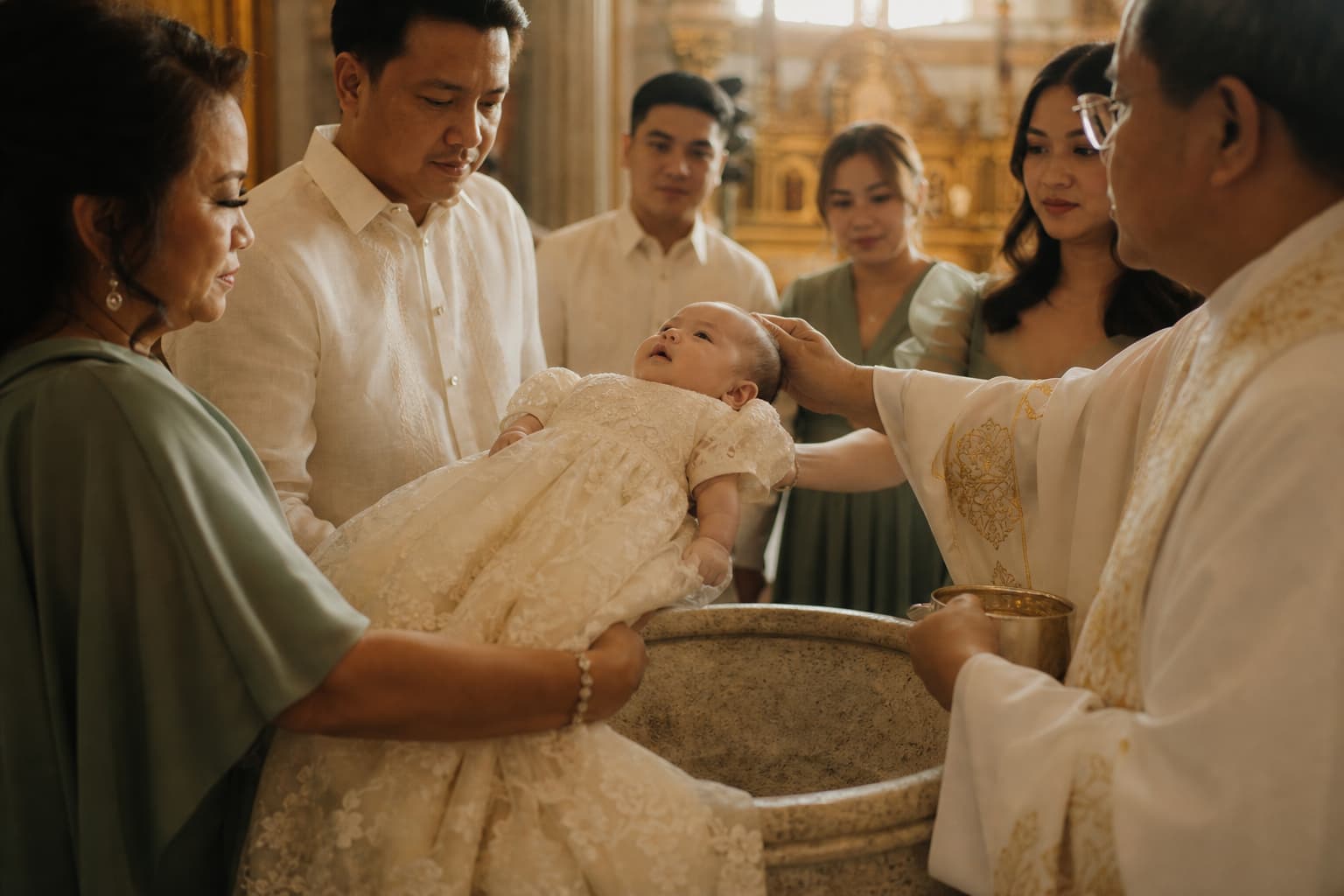
Use whichever one your family already says. Binyag is the everyday Filipino word, baptism is the sacrament's name and the one the parish uses, and christening is the English social term. They describe the same morning, and the only wrong answer is a word your own relatives would not use.
| Word | Where it fits | Who says it |
|---|---|---|
| Binyag | The whole day, spoken | Most families, most of the time |
| Baptism | The rite itself, and parish paperwork | The church, and formal invitations |
| Christening | The social celebration | English-language invitations |
We would not put christening on an invitation for a family who have called it a binyag for four generations. It is a small thing that reads as somebody else having written your invitation for you.
How to word the invitation itself
Parents first, then the child, then the sacrament, then the details. The traditional shape is one sentence: the parents invite you to the baptism of their daughter, followed by the date, the parish and the reception. Everything after that sentence is logistics rather than wording.
- The formal version
- Mr and Mrs Reyes request the pleasure of your company at the baptism of their daughter, Elena Marie.
- The warmer version
- Ramon and Cristina invite you to the binyag of their daughter, Elena Marie, and to lunch afterwards.
- With grandparents included
- Together with her grandparents, Ramon and Cristina invite you to the binyag of their daughter.
- For a second child
- No change needed. There is no convention here that treats a second binyag as a smaller occasion.
The child's full name goes on it as it will be entered in the parish register, including the second name. That register entry is a document she will need for the rest of her life, and the invitation is often where the family first sees it written out.
Listing ninong and ninang when there are twenty-four
Group them, name every single one, and do not abbreviate. Twenty is common at a Filipino christening and forty happens. Every person who was asked to stand belongs on the invitation by name, because being asked is a real thing and seeing your name is part of it.
- Group them as ninong and ninang rather than mixing the two lists together
- Use the names people are actually called, with the titles they use
- Keep married couples adjacent, because that is how they will be read out
- Never write and others, or et al, however long the list is
- Check each spelling with each family rather than assuming
This is the practical reason a page helps
A folded card runs out of room somewhere around the twelfth name, and a layout that was designed for six starts to look broken at thirty. A page does not, and it also lets you add the ninang who was asked a week before the binyag.
Our christening invitations put the godparents on their own page for exactly this reason, and there is no cap on how many.
What godparents specifically need told
Four things a general guest does not need: what time to be at the church rather than the reception, where to stand during the rite, whether they are expected to say or carry anything, and whether the parish wants a baptismal certificate or a seminar beforehand. That last one catches families out.
Many parishes require godparents to be confirmed Catholics and some ask for a certificate or attendance at a short seminar. Finding that out two days before, with twenty-four godparents to inform, is a genuinely bad week. Ask the parish when you book the date.
- Call time, separately
- Godparents usually need to be there before the guests, and often before the parents. Give them their own time.
- Where to stand
- Most people have not done it before and would rather not be arranged on the spot in front of everyone.
- Whether they carry anything
- The candle, the cloth, the shell. Say who is holding what, or several people will assume it is not them.
- Parish requirements
- Certificate, seminar, or a confirmation date. Ask the parish once and tell all of them at the same time.
Would you rather hand it over?
The details for everybody else
The parish name and a map pin, the rite time and the reception time separately, the dress code, and whether lunch follows. A binyag usually moves from a church to a restaurant or a house, and the gap between the two is where guests get lost or arrive an hour early.
Give both venues their own map pin rather than one address and an assumption. Half of Philippine addresses need a landmark to be findable at all, and a parish that shares a name with three others in the province needs the city on it.
A christening invitation from us is ₱999, with every godparent named and both venues on one link. If you want the wording for other occasions, there is a piece on wedding wording that covers the trickier family situations.
Asked about this
How do you word a christening invitation?
Parents first, then the child's full name, then the sacrament, then the details. Something like Ramon and Cristina invite you to the binyag of their daughter, Elena Marie, followed by the date, the parish and the reception afterwards.
Should I write binyag, baptism or christening?
Whichever your family already says. Binyag is the everyday word, baptism is what the parish calls the rite, and christening is the English social term. They mean the same day, and the only wrong choice is a word your relatives would not use.
Do I have to list all the ninong and ninang on the invitation?
Yes, by name, however many there are. Twenty is common and forty happens. Being asked to stand as ninong or ninang is a real request, and seeing your own name on the invitation is part of how that request is honoured.
What do godparents need to know that other guests do not?
Their own call time at the church, where to stand during the rite, whether they are carrying the candle or the cloth, and any parish requirement such as a confirmation certificate or a seminar. Ask the parish about that last one when you book.