How it works
How digital invitations work, from first message to last photo
Digital invitations work in six steps here, and two of them are yours: telling us about the day, and saying what you want changed. We do the other four. Your first draft lands in three to five days, and from then on it is one private link, with every reply, every message and every photo coming back to the same page.
About two minutes to start · Nothing due until we have spoken · First draft in three to five days
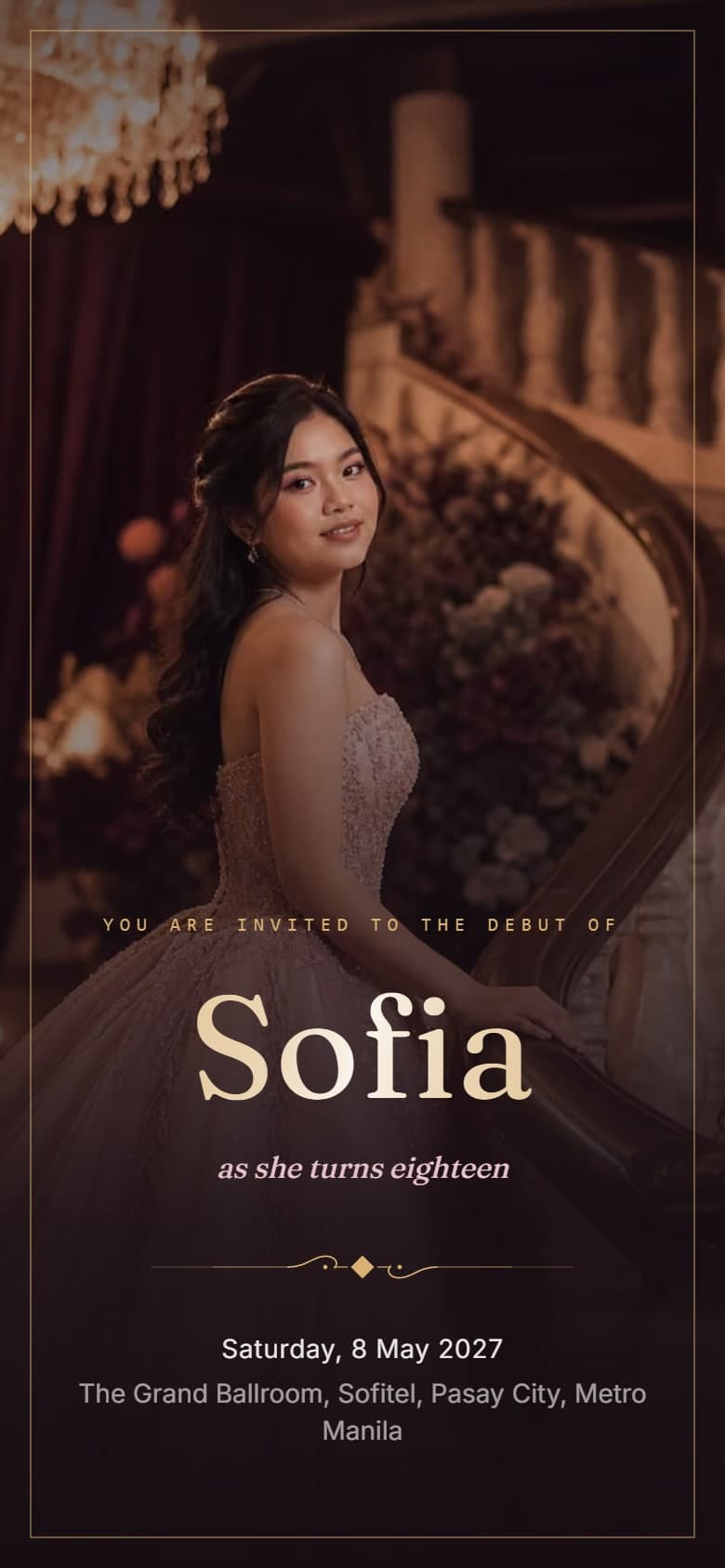
Start to finish
The six steps, and which two are yours
Six steps, in order: you tell us about the day, we talk it through on a short call, we draw it, you say what to change, it goes live on one private link, and everything your guests leave comes back to you. The first draft arrives three to five days in.
Nothing in the middle is yours to assemble. There is no editor to log into, no template to fight with and no deadline that belongs to you rather than to us.
- Yours01
You tell us about the day
The occasion, the date, a rough headcount and any direction on the look. About two minutes on the form, and it is the only building you will do.
- 02
We talk it through
A short call about the day, on Messenger, Viber or the phone. We agree the sections it needs, the direction and the price, all before anything is paid.
- 03
We draw it
Your first draft in three to five days, or inside 48 hours on rush. Drawn from your details for your day, never a template with your names dropped into it.
- Yours04
You say what to change
A voice note, a screenshot with an arrow on it, or a list. Every invitation comes with 2 rounds of changes, and typos are never one of them.
- 05
It goes live on one link
One private link, a QR code for the door and a preview image sized for Messenger. You send it however you already talk to people.
- 06
Everything comes back to you
The replies, the messages your guests leave for the celebrant and every photo they take, on one page only you can open. The link stays up for 12 months.
Step one is the form, and it takes about two minutes. Nothing is due until we have spoken.
Step one
What you send us at the start, and what can wait
Four things about the day start it: the occasion, the date, a rough headcount and any direction on the look, plus a name and one way to reach you. About two minutes in all. The rest, the programme, the venue notes and the full list of ninong and ninang, can follow while we are already drawing.
What the form asks
- The occasion
- A wedding, a binyag, a debut, a despedida. It decides both the sections and the price.
- The date
- Or a tick to say it is not fixed yet, which is a perfectly normal answer.
- A rough headcount
- It does not change the price. We ask so we know what we are laying out.
- The look, roughly
- A colour, a motif, or a photo of something you liked, described in words.
What can come later
- The programme
- Call time to last song. Most people are still deciding this when we start.
- The venue notes
- Parking, the floor, the landmark a driver would need.
- Every name
- The entourage, the principal sponsors, the ninong and ninang, spelled the way your family spells them.
- The attire
- The palette, and a look or two so nobody has to guess what sage means.
Most people arrive with a colour and half a programme, and that is enough to begin. If you would rather do the whole thing yourself, we have written how to make digital invitations honestly enough to follow without us.
Step two
What the call is for
A short call about the day, usually the same day your form arrives, on Messenger, Viber or the phone if you would rather. We agree the sections your occasion needs, the direction of the look and the price, all three before a peso changes hands. Deciding it is not for you is a perfectly good ending.
What gets settled
- Which sections your day actually needs
- The direction of the look, and anything to avoid
- The price, confirmed rather than estimated
- When your first draft will land
What to bring to it
- A colour, or a photograph you kept
- The venue, even if it is only a shortlist
- A rough guest number, not a list
- Or nothing at all, and we will ask
It is a conversation about your day rather than a sales call. Plenty of them end with us saying a smaller invitation would do, or that the date is far enough off that there is no hurry.
Steps three and four
How your invitation gets drawn, and how changes work
Your first draft arrives three to five days after we have your details, or inside 48 hours for a ₱999 rush if the date is close. Then 2 rounds of changes, sent however suits you: a voice note, a screenshot with an arrow on it, or a list in a message. We make them.
- What you get
- A private link, a QR code for the day, and a preview image sized for Messenger and Viber.
- Turnaround
- First draft in three to five days once we have your details, and we can go faster if the date is close.
- Revisions
- 2 rounds on every invitation, at every price. Typos and detail changes are always free, before and after it goes live.
Typos are not a round. A second name spelled the short way, a call time that moved by half an hour, a ninang who was left off the list: those we fix for free, before the invitation goes live and for as long as it is up. Nobody should have to spend one of their two rounds on a missing letter.
Paying
How and when you pay
GCash or bank transfer, in two parts: 50 percent after the call once the price is agreed, and the balance before your invitation goes live. One payment per event, nothing recurring, and prices run from ₱999 for a binyag to ₱4,999 for a wedding. Then we get on with drawing.
- Nothing before we speak
- The price is agreed on the call. Until then there is nothing to pay and nothing you are committed to.
- 50 percent after it
- Send a screenshot of the GCash or bank receipt, we confirm it, and the drawing starts.
- The balance before it goes live
- Paid once the invitation is finished and you have seen it. One payment per event, nothing recurring.
Every occasion, every add-on and what each one includes sit on the digital invitation prices page, and nothing quoted on the call is different from what is written there.
Step five
Sending it out, and where the replies land
You get one private link, a QR code for the door and a preview image sized for Messenger. Share it however you already talk to people. The replies land on a page only you can open, showing seats confirmed against seats still held and the names yet to answer. No guest cap, at any price.
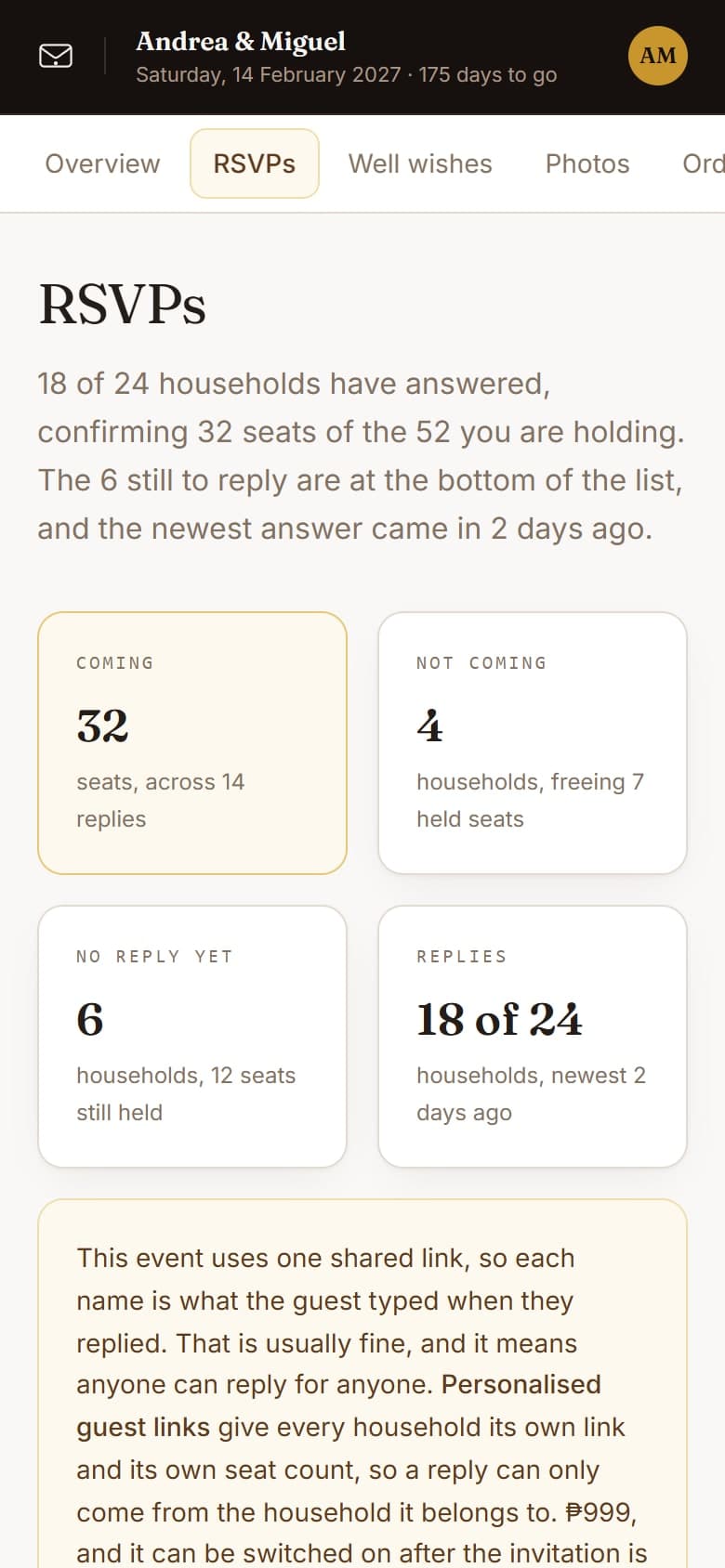
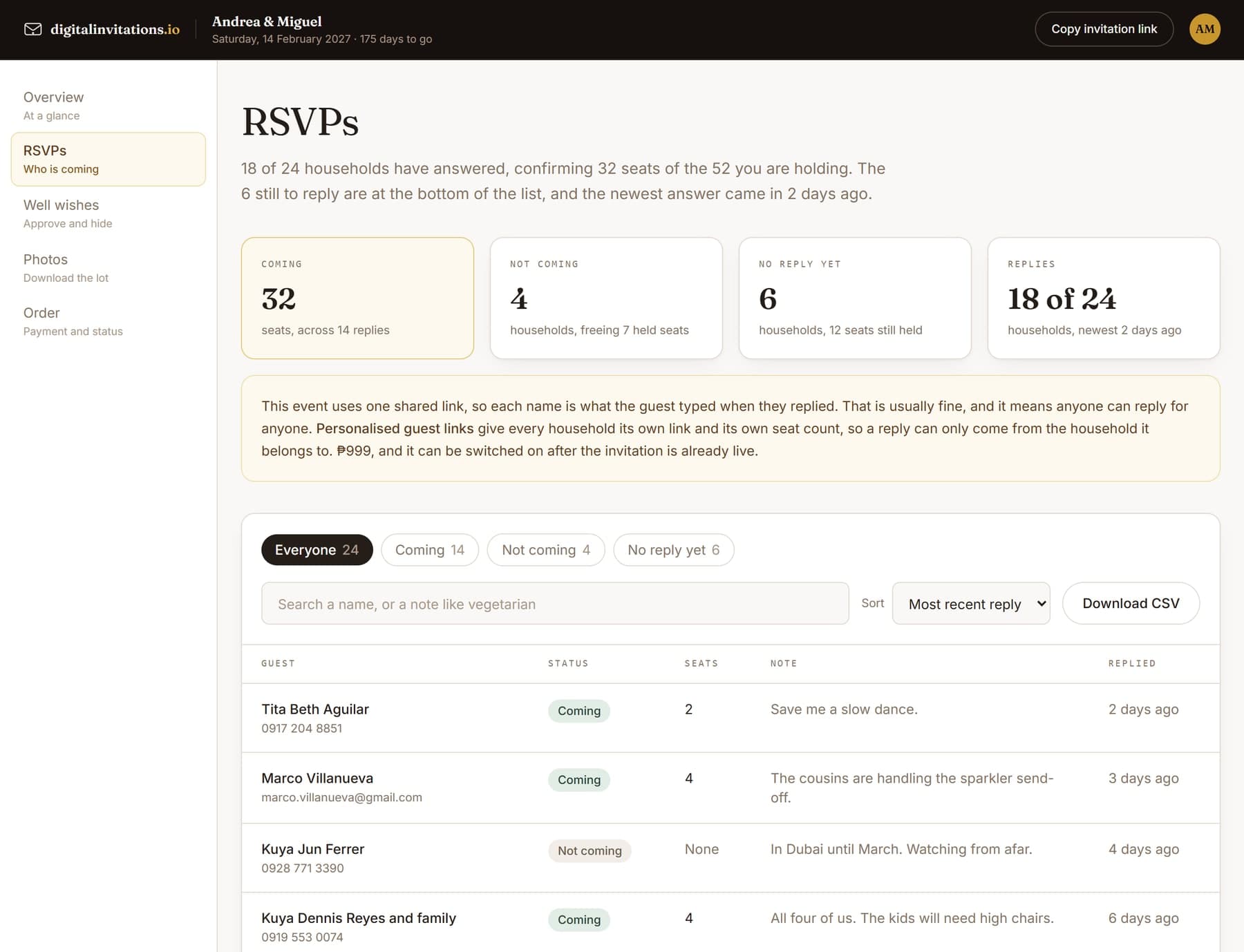
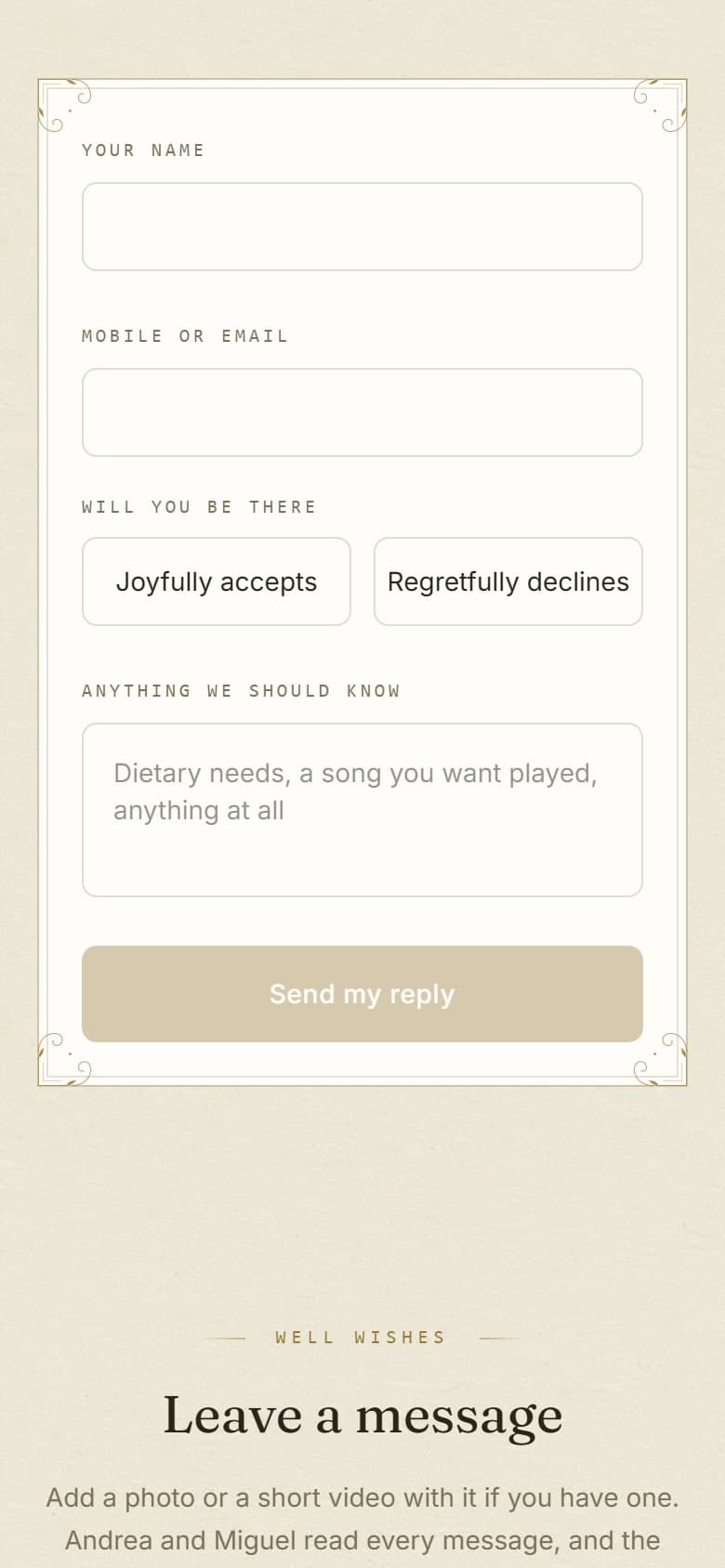
Andrea and Miguel is a sample wedding our studio designed. Every guest name, number and note on the screens above is invented.
And if chasing the last few replies is one job too many on top of everything else, we will do that part for you. Managed RSVP is ₱999, and you get a final headcount before your caterer needs one.
Step six
The day itself, and what comes back after it
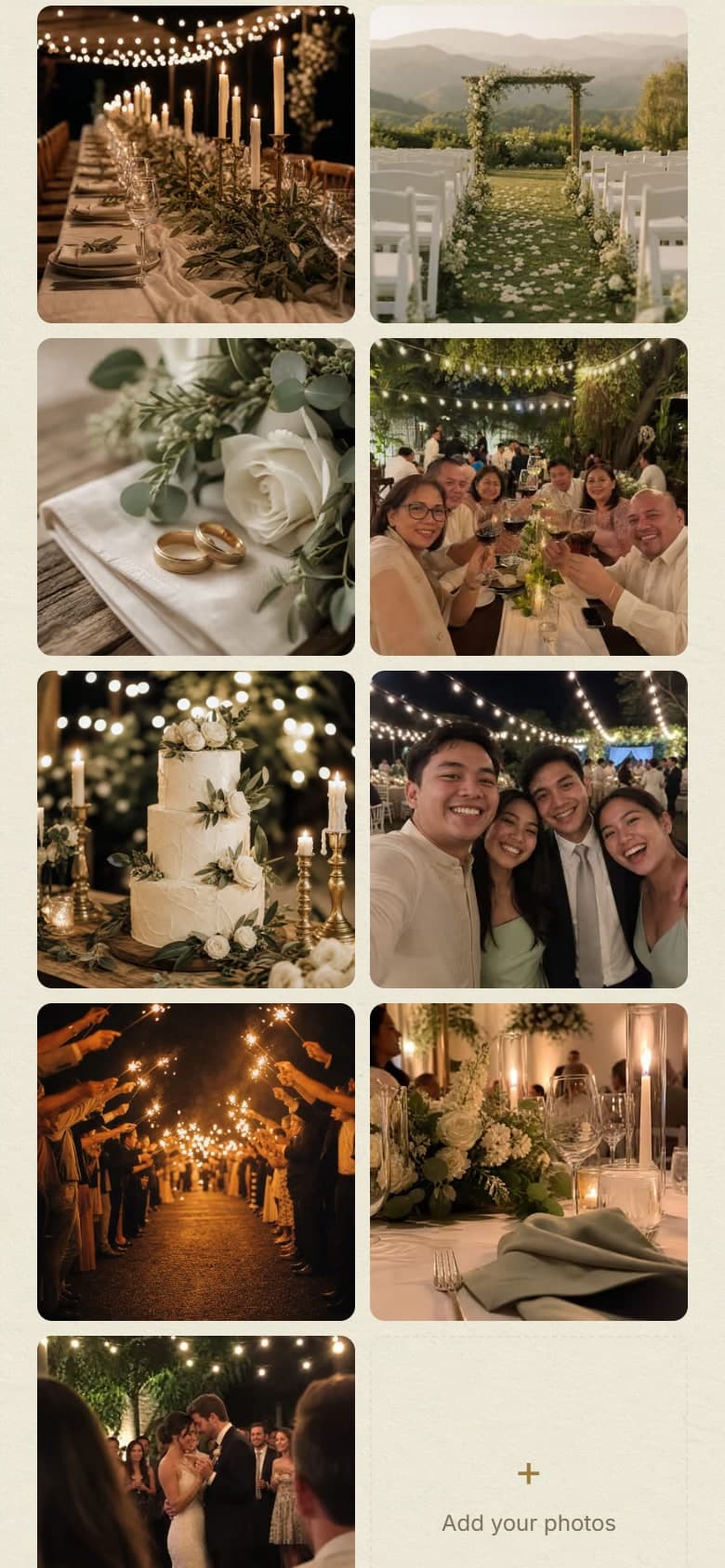
On the day your guests upload photos from their seats, so you end up with the whole day from every table rather than the corner you were standing in. You download the lot at full resolution any time in the 90 days afterwards, and the invitation itself stays up for 12 months with the photos still on it.
The messages
Guests write to the celebrant on the invitation itself and it stays there for everyone to read. Hold them for approval first if you would rather. It is usually the part people go back to.
The photographs
Every camera in the room, in one download at full quality. Your photographer gives you the posed record of the day. This gives you the one nobody was posing for.
This is the part people open months later, and it is the reason the link outlives the day. If you would rather keep the photos longer, the window extends to a full year for ₱499, and you can decide that after the day rather than before it.
Questions
Asked about the process
How long it takes end to end, what happens when the venue moves, what to do if the first draft is wrong, and how far ahead to start. Short answers below, and anything they miss can go on the call.
How long does the whole thing take, from the form to going live?
Usually a week to two. Your first draft is three to five days once we have your details, each round of changes is a day or two, and it goes live the moment you are happy with it. If your date is closer than that, a 48-hour rush is ₱999.
Can I edit the invitation myself?
No. You send us the change and we make it, usually the same day, so there is no editor to log into and no password to keep. Typo and detail fixes are free for as long as the invitation is up, and no half-finished draft ever sits in an account waiting for you.
What if the venue or the time changes after it is live?
We change it and every guest sees the new version, including the ones who opened it weeks ago, because there is only ever one link. Venue moves, time changes and typo fixes cost nothing, before or after it goes live. You never have to send a correction.
What if I do not like the first draft?
You say so, and we draw it again. Every invitation at every price comes with 2 rounds of changes, and a first draft is there to be argued with. If the whole direction is wrong, tell us on the first round and the second is a new direction rather than a tidy-up.
Do you need our full guest list before you start?
No. A rough headcount is enough, and it does not change the price. The only thing that needs the real list is personalised guest links, where each household opens a page addressed to them by name, and that is a ₱999 add-on you can decide on later.
How far ahead should we start?
Whenever you have the date. Six to eight weeks before the day is comfortable, and a wedding with an entourage and a long programme is easier with three months. Later is fine too. School and parish dates often arrive late, and a 48-hour rush is ₱999.
From the journal