Invitation websites, and how to tell whether you need one
Invitation websites are invitations that live on a link instead of on paper, and the difference is not the screen. It is that a page can keep working after somebody has read it: taking replies, holding the programme, and collecting the photographs afterwards. Whether you need one depends less on the size of the event than on how much of it you are carrying alone.
Invitation formats6 min read
What an invitation website actually is
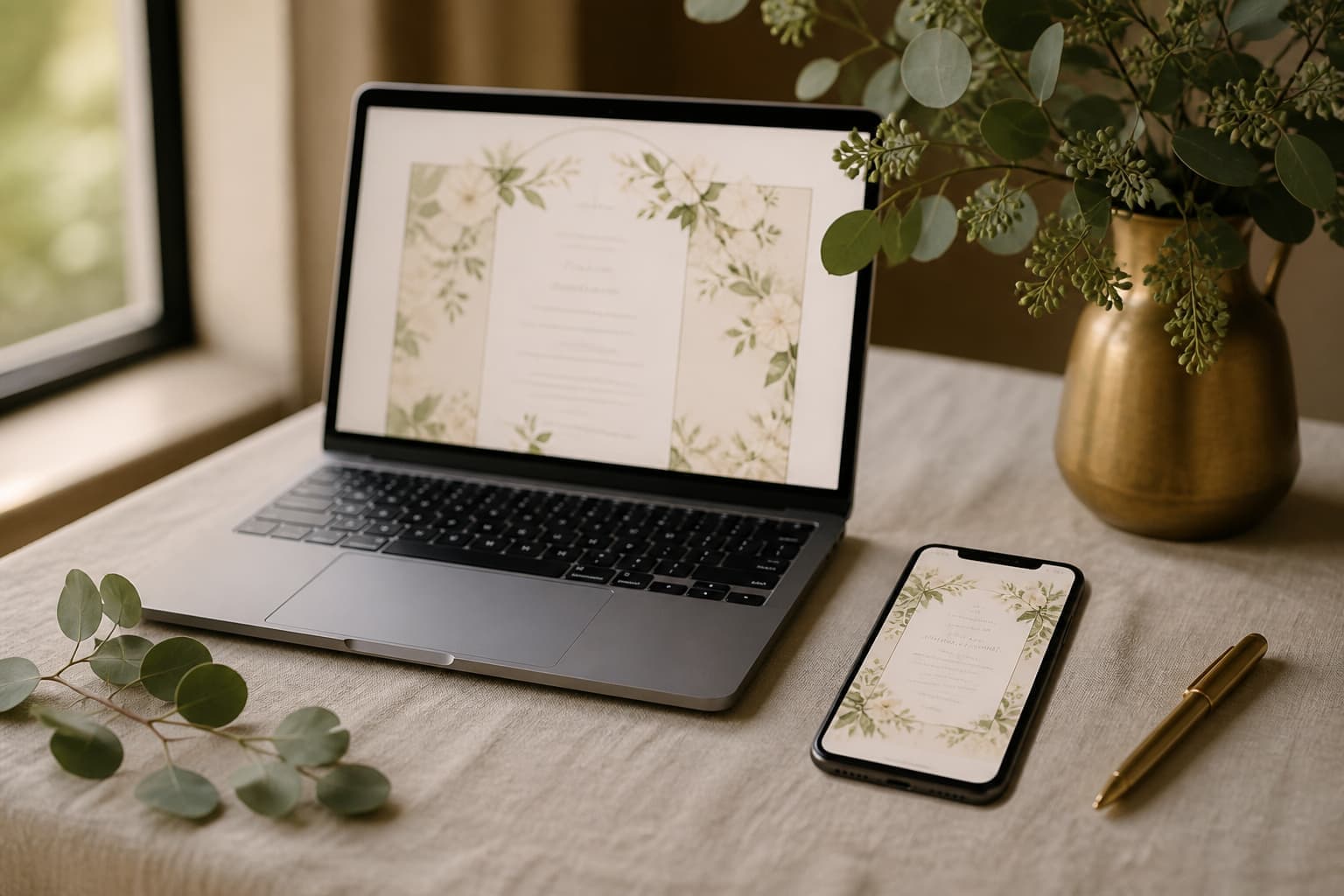
An invitation website is a single web page, or a small set of them, built for one event and reached by one link. It carries the names, the date and the venue like a card does, and then adds the parts a card has no room for: the programme, a map, a reply form and somewhere for photographs to land afterwards.
The word website makes people picture something bigger than it is. Nobody is building a company site here. In practice it is one page a guest scrolls on their phone in about forty seconds, which is roughly the attention a printed invitation gets too. The difference is what happens on the forty-first second, when a card has finished its job and a page has not.
Most people here say e-invitation rather than invitation website, and they mean the same thing. If the vocabulary is the confusing part, we have written that up separately.
What goes on one that a card cannot hold
Four things, mainly: a reply form that counts seats rather than yeses, a programme that can change without reprinting, a map that opens in Waze with one tap, and a place for guest photographs. A folded card can carry a QR code to all of that, but it cannot carry the thing itself.
- Replies with names on them
- One reply covers a household, so a tita answering for four is one reply for four rather than four unknowns.
- A programme that stays current
- Call time moves by half an hour and every guest sees the new one, including the ones who read it in March.
- Directions rather than an address
- A map pin, a landmark and a parking note. Half of Philippine addresses need the landmark to be findable at all.
- Somewhere for the photographs
- Guests upload from their seats and you download the lot afterwards, instead of asking forty people for their camera rolls.
The part people underrate
It is the last one. Everybody expects the RSVP to be useful and it is. The thing couples come back and mention is that the photographs from every table are in one place, which is the part no printed invitation and no group chat has ever managed.
Who genuinely needs one, and who does not
You need one when the guest list runs past about a hundred, when the day moves between two venues, or when the programme is long enough that people will ask questions. You do not need one for a lunch for twenty at your parents' house, and anybody telling you otherwise is selling something.
A small, simple gathering is genuinely better served by a nice image in the group chat. You will know everyone who is coming because you can count them in your head, and the venue is a place they have all been before. Spending money on a page for that is spending money on nothing.
| The event | Card or image | A page on a link |
|---|---|---|
| Lunch for twenty at home | Enough | Not worth it |
| Binyag with thirty ninong and ninang | Runs out of room | Worth it for the list alone |
| Debut with a full programme | Cannot hold the order | Worth it |
| Church and reception an hour apart | Two addresses, no directions | Worth it |
| Wedding for three hundred | Cannot give you a headcount | Worth it |
The honest test is not the guest count. It is whether you are the person currently holding all of the answers in your head, because that is the job a page takes off you.
What invitation websites cost in the Philippines
Free if you build it yourself on a template site, and roughly PHP 1,500 to PHP 8,000 for a done-for-you one designed around your event. Ours run from ₱999 for a binyag or a kids' party to ₱4,999 for a wedding of up to 400 guests.
The free route is real and we say so on the guide about making your own. What it costs instead is your evenings, and the fact that the replies, the details and the photographs end up living in three separate places that you are the only person joining up.
In the done-for-you range, what moves the number is how much invitation the day needs rather than how custom the design is. A wedding carries an entourage, principal sponsors and a run from the church to the reception; a binyag carries one rite and a lunch. Every occasion price sits on one page if you want to compare them.
Would you rather hand it over?
The one thing to check before you commit to one
Ask whether the page can be found by a search engine, and ask where the guest list is stored. An invitation carries your home address, your family's names and your event photographs. On ours the link is private and search engines are told not to index it, which is a setting somebody has to have chosen.
This sounds like a technicality and it is not. A public invitation page means a stranger can search your surname and read the time you will all be at the church, and every photograph your guests uploaded on the day. Plenty of template sites default to public because a public page is easier for them to show off.
- Is the invitation itself blocked from search engines?
- Who else can see the guest list, and can you export it?
- Does the link keep working after the event, and for how long?
- What happens to the photographs when the account lapses?
For what it is worth, ours stays up for 12 months, the guest photos stay downloadable for 90 days, and the whole reply list exports as a spreadsheet whenever you want it.
Asked about this
Is an invitation website the same as a wedding website?
Nearly. A wedding website is usually the bigger one, with a story page, a registry and a gallery, and it is often up for months before the invitation goes out. An invitation website is the invitation itself, on a link, with the reply and the details on it.
Do guests need an app or an account to open it?
Not on a well-built one. A guest taps the link and it opens in whatever browser is already on their phone. Asking somebody to make an account before they can reply is the single quickest way to lose the replies from your older relatives.
Can I still print something if I have an invitation website?
Yes, and plenty of people do. The usual arrangement is a printed card for the lolas and the ninongs with a QR code on it, and the link for everybody else. You are not choosing a side, you are choosing what each group gets handed.
What happens if the venue changes after I have sent the link?
The page changes and every guest sees the new version, including the ones who opened it weeks ago, because there is only ever one link. With a printed card or a sent image you are sending a correction and hoping the right one is the one people kept.